Where to play Mines in Ireland
Three from our list of ten with the game and a proper crash section around it. All are international casinos accepting players from Ireland; none holds an Irish licence.
#CasinoWelcome offerFree spinsWagering
01
HitnSpinWidest crash section of the ten
up to €1,500
250 free spins40×Visit site
02
BetlabelCasino and sportsbook on one account
up to €1,500
150 free spins35×Visit site
03
CorgiBetMost free spins on the list
up to €4,500
350 free spins35×Visit site
Game availability changes — check the operator's own lobby before signing up for a specific title. Wagering is the multiple in the operator's own bonus terms; winnings from free spins are often wagered separately, at a higher figure. Amounts and conditions change without notice, so read the terms on the operator's site before you accept anything.
How the Mines game works
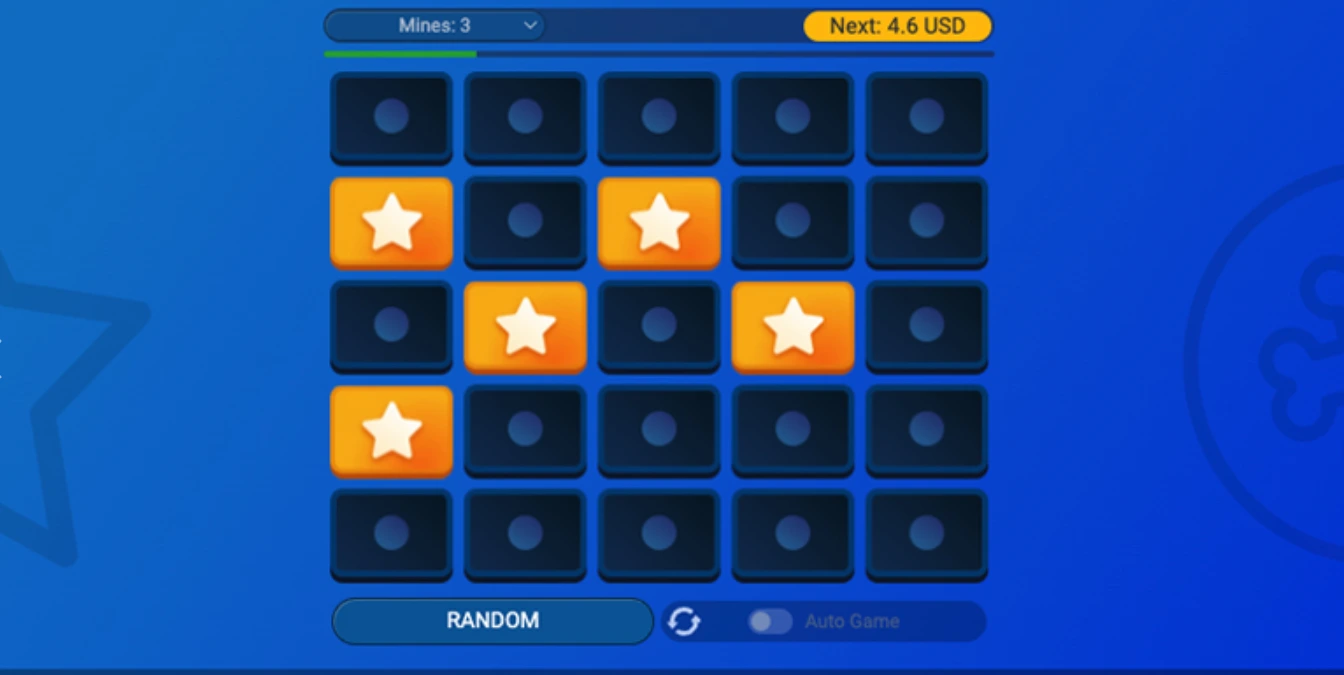
You get a grid, usually 5×5 for twenty-five tiles. You choose how many bombs to hide in it, anywhere from one to twenty-four. You place a stake and start turning tiles over. Every safe tile pushes the multiplier up. Hit a bomb and the round ends with nothing. Cash out whenever you like and take the multiplier as it stands.
The bombs are placed before your first click and do not move. There is no mechanism that punishes a winning streak, and no version of the game that decides you have had enough — the layout is fixed when the round begins, and every tile you have not turned is equally likely to be one of them.
The sums, worked through
This is the part no other crash game lets you do. With 3 bombs in a 25-tile grid, your first click is safe 22 times out of 25 — 88%. If it is safe, the second click faces 3 bombs among 24 remaining tiles, so 21 in 24, or 87.5%. The third is 20 in 23, about 87%.
Each individual click looks comfortable. The trouble is that they multiply. To turn over five tiles in a row you need all five to be safe, and that is 0.88 × 0.875 × 0.87 × 0.864 × 0.857, which comes to about 50%. Five clicks that each felt like a near-certainty, and it is a coin flip.
Push to ten safe tiles with 3 bombs and you are at roughly 11%. That is the whole psychology of the game in one line: the individual step always feels safe, and the sequence never is.
The payouts follow this exactly, minus the house edge. A multiplier of about 2× arrives at the point where your chance of getting there is about half, which is precisely what a fair price looks like — and then roughly 3% is shaved off it, which is where the 97% RTP comes from.
More bombs or more tiles?
The two dials do different things and people tend to move the wrong one.
Few bombs, many tiles. Three bombs and a plan to turn eight tiles is a long, slow round with a modest multiplier at the end and a decent chance of getting there. This is the configuration for playing for a while.
Many bombs, few tiles. Fifteen bombs and a plan to turn two tiles is over in seconds and pays several times the stake when it works. With 15 bombs, the first tile is safe 10 times in 25 — 40% — and two in a row is about 15%. Fast, brutal, and honest about what it is.
What does not work is many bombs and many tiles, which is the combination people drift into after a good round. With 15 bombs, five safe tiles in a row happens about 1% of the time. The multiplier on offer is enormous, and it should be.
Decide before you click
Mines has no auto cash-out in most implementations, which puts more weight on your own discipline than Aviator does. The useful habit is to pick the number of tiles before the round starts and stop there regardless of how the round has felt.
The reason is the same one that catches people in every crash game: after four safe tiles in a row, the fifth feels safer than it is. It is not. It is the same 86% it was always going to be, and the 14% has now had four chances not to happen. Deciding in advance takes that entirely out of the equation.
Most versions do offer auto-pick, which chooses random tiles for you. It changes nothing mathematically — every unturned tile carries identical odds — but it does stop people hunting for patterns in a grid that has none.
Where Mines sits in the format
Against Plinko, Mines gives you decisions where Plinko gives you settings. Against Aviator, it replaces a five-second nerve test with something closer to a calculation. Of the three it is the one we would suggest starting with, precisely because the odds are visible: play it for an evening and the way probability compounds stops being an abstraction.
The underlying maths is the same across all three, and the explainer covers where the house edge sits and why no betting system gets around it.
Before you accept a bonus: Mines and the other crash titles frequently count 10% or 20% towards wagering where slots count 100%, and at some operators nothing at all. Check the game contribution table in the bonus terms first.
Common questions
What are the odds in the Mines game?
Calculable, which is what makes it unusual. With 3 bombs in 25 tiles the first click is safe 22 times in 25, or 88%. But the clicks multiply: five safe tiles in a row comes to about 50%, and ten to about 11%. Each individual step feels comfortable and the sequence is anything but — that gap is the entire game.
How many bombs should I set?
It depends on the round you want. Three bombs with a plan to turn eight tiles is a long round with a modest multiplier and a fair chance of reaching it. Fifteen bombs with a plan to turn two is over in seconds and pays several times the stake. What does not work is many bombs and many tiles — with 15 bombs, five safe tiles happens about 1% of the time.
Can you tell where the bombs are?
No. They are placed before your first click and every unturned tile carries identical odds, so there is no pattern to read and no corner that is safer than the middle. The auto-pick button exists partly for this reason: it changes nothing mathematically, but it stops people hunting for structure in a grid that has none.
What is the RTP of Mines?
Around 97% at most providers. You can see the edge directly if you compare the payouts to the true odds: the multiplier offered at each step sits just below what a fair price would be, and that gap of roughly 3% is the house margin. Operators can configure the figure, so check the game's own info panel.
Is Mines a good game to start with?
It is the one we would suggest, precisely because the odds are visible. Play it for an evening with three bombs and you get a practical education in how probability compounds — the fifth safe tile is exactly as likely as the first, and the run of five is half as likely as it feels. That lesson transfers to every other game in the format.