Where to play Plinko in Ireland
Three sites from our list of ten that carry it alongside a proper crash section. All are international casinos accepting players from Ireland; none holds an Irish licence.
#CasinoWelcome offerFree spinsWagering
01
HitnSpinWidest crash section of the ten
up to €1,500
250 free spins40×Visit site
02
RollXOBiggest headline offer on the list
€15,000
350 free spins40×Visit site
03
iviBetThe only bonus cap you can realistically clear
100% up to €300
170 free spins40×Visit site
Game availability changes — check the operator's own lobby before signing up for a specific title. Wagering is the multiple in the operator's own bonus terms; winnings from free spins are often wagered separately, at a higher figure. Amounts and conditions change without notice, so read the terms on the operator's site before you accept anything.
How a Plinko casino game works
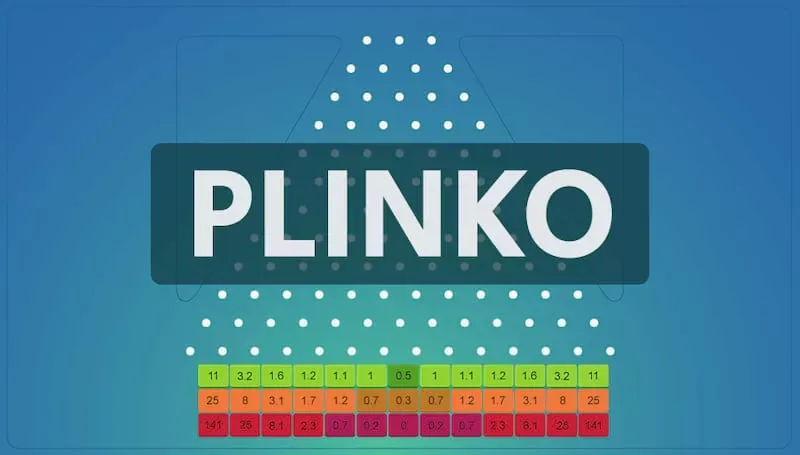
You pick a stake, you press drop, a ball falls through rows of pegs bouncing left or right at each one, and it lands in a multiplier slot at the bottom. Multiply the stake by that number and you have your result. There is no timing decision, no cash-out button, no waiting — which makes it the gentlest game of the crash family and the easiest to play far too many rounds of.
The multipliers sit in a curve. The big ones are at the outside edges, the small ones in the middle, and the middle is where the ball lands most of the time. That is not a design choice, it is arithmetic: a ball bouncing randomly at each row ends up near the centre far more often than at an edge, in the same way that rolling two dice gives you a seven more often than a two.
The two settings that change everything
Rows. Usually anywhere from 8 to 16. More rows means more bounces, a wider spread of outcomes, and bigger multipliers available at the edges — but the edges also get proportionally harder to reach. Fewer rows flattens everything: smaller top prizes, but the ball lands somewhere useful more often.
Risk level. Low, medium or high, and this is the one that actually matters. It reshapes the entire multiplier curve. On low risk the centre slots pay close to your stake back and the edges are modest. On high risk the centre pays a fraction of your stake and the edges carry the big numbers.
Here is the part worth internalising: the RTP barely changes between them. It stays around 97% to 99% whatever you pick. The settings do not make the game more or less generous — they decide whether you lose slowly and steadily or in a jagged line with occasional spikes.
What each setting feels like in money
Say you are playing €1 a drop with 16 rows.
Low risk. Most drops return somewhere between €0.50 and €1.10. You will rarely be far from where you started after fifty rounds, and the biggest edge slot is worth perhaps 16×. This is the setting for playing for an hour on a small balance, and almost nobody chooses it.
High risk. Most drops return around €0.20 — you lose four fifths of the stake on the majority of rounds — and the edge slots run to 1,000× the stake. Long stretches of nothing, punctuated by something that changes the session. This is the setting everyone picks, and it is why Plinko has a reputation for eating balances.
Neither is wrong. But choosing high risk while intending to play for an hour is choosing the wrong tool for the job, and that mismatch is the single most common mistake in the game.
Auto-drop is where the money goes
Plinko rounds take about a second, and every version offers an automatic mode that will run hundreds of them for you. This is the fastest way to lose money available in an online casino — not because the odds are bad, but because volume multiplied by house edge is the whole equation.
Run 500 automatic drops at €1 on a 97% game and the maths takes roughly €15. That is not a disaster. Run 5,000 and it takes €150, and 5,000 drops is about ninety minutes of automatic play. The percentage never changed. The number of rounds did.
If you use auto, set the loss limit at the same time. Every implementation offers one, and it is not there for decoration.
Plinko compared to the rest of the format
Against Aviator, Plinko removes the decision. There is nothing to time, nothing to hold your nerve on, no moment where you watch a multiplier climb past the point you meant to leave. For some people that is a relief and for others it removes the point of the game.
Against Mines, Plinko removes the calculation. In Mines you can work out the exact probability of the next tile before you click it. In Plinko you are handed a curve and asked to pick a shape. Less to think about, and less to get right.
The maths underneath all three is the same: a fixed house edge, applied to whatever you put through it. The explainer covers where that edge sits and why no betting system gets around it.
Before you accept a bonus: Plinko and the other crash titles frequently count 10% or 20% towards wagering where slots count 100%, and at some operators nothing at all. Check the game contribution table in the bonus terms first.
Common questions
What is the RTP of Plinko?
Between about 97% and 99% depending on the provider, which makes it one of the more generous games in an online casino on paper. It barely moves between risk levels — low, medium and high reshape the payout curve rather than changing how much the game gives back overall. The figure in the game's own info panel is the one that applies to you.
Does high risk pay better in Plinko?
Not overall — the return to player is roughly the same on all three settings. What high risk changes is the shape: most drops come back at a fraction of your stake, and the edge slots carry very large multipliers. You lose more often and win bigger when you win. For an hour of play on a small balance, low risk lasts far longer.
How many rows should I use?
More rows widen the spread — bigger multipliers at the edges, but proportionally harder to reach, since a ball bouncing randomly ends up near the centre far more often. Fewer rows flattens everything into smaller, steadier outcomes. Combined with a low risk level, fewer rows is the gentlest configuration available.
Is there a Plinko strategy that works?
No. Each drop is independent and the house edge is fixed, so no pattern of stakes or settings changes the expected result. The only genuine decisions are how much you stake, how many rounds you play, and whether you set a loss limit before using auto-drop — and the third one matters more than people expect at a game that runs a round per second.
Why do I lose so fast on auto-drop?
Volume. A Plinko round takes about a second, so 5,000 automatic drops is roughly ninety minutes. At €1 a drop on a 97% game, the maths takes about €150 across those 5,000 rounds — the percentage never changed, only the number of rounds did. Set the loss limit at the same time you set the auto-drop.